


There are mountains that people climb for adventure, mountains they admire for their beauty, and then there are mountains that people worship.
Nanda Devi belongs to the last category.
Rising dramatically in the Garhwal Himalayas, Nanda Devi is more than one of India’s most impressive peaks. For the people of Uttarakhand, she is deeply connected with faith, tradition, folklore and the identity of the mountain communities. Her name is associated with Goddess Nanda, a revered form of the divine feminine, and her presence can be felt in everything from village temples and local traditions to the extraordinary Nanda Devi Raj Jat Yatra.
At 7,816 metres, Nanda Devi is the second-highest mountain in India and one of the most prominent peaks of the Himalayas. The mountain is surrounded by a dramatic landscape of deep gorges, glaciers, alpine meadows and high Himalayan peaks.
But numbers alone cannot explain why Nanda Devi holds such a special place in Uttarakhand.
For generations, people have treated these mountains not simply as wilderness but as sacred territory. Stories of Goddess Nanda, Lord Shiva, ancient kings, mysterious lakes and difficult pilgrimages have become part of the cultural landscape.
What Makes Nanda Devi So Special?
Nanda Devi stands in the Garhwal Himalayas of Uttarakhand and rises to 7,816 metres above sea level. The mountain is part of a larger massif and is surrounded by some of the most dramatic terrain in the Indian Himalaya.
The mountain’s geographical setting is extraordinary. The Nanda Devi Sanctuary is enclosed by a ring of high peaks, while the Rishi Ganga cuts through an exceptionally deep gorge before emerging from the sanctuary.
For mountaineers, this landscape represents a serious technical challenge. For local communities, however, its importance goes much deeper.
Nanda Devi is regarded as a goddess.
The name itself is closely associated with Nanda, the beloved goddess who has been worshipped across the Himalayan region for centuries. In the traditional imagination of Uttarakhand, the mountain is not merely an object in the landscape. It is connected with the divine.
This relationship between mountain and deity explains why many stories surrounding Nanda Devi are filled with ideas of respect, devotion, punishment, pilgrimage and spiritual transformation.
Nanda Devi and Goddess Nanda
The cultural identity of Nanda Devi cannot be separated from Goddess Nanda.
Nanda is worshipped widely across Uttarakhand, and in many local traditions she is regarded as a daughter of the mountains. Some traditions connect her with Goddess Parvati and the world of Lord Shiva.
This association becomes particularly meaningful in the high Himalayas.
The mountains are often imagined as the home of the gods, and Nanda Devi’s journey toward the higher Himalayan regions is therefore understood through a deeply spiritual lens.
For people living in the surrounding valleys, Nanda Devi represents more than power and grandeur. She is associated with protection, prosperity, family and the emotional bond between a goddess and her people.
That connection is most dramatically expressed through the Nanda Devi Raj Jat Yatra.
Nanda Devi Raj Jat Yatra: A Pilgrimage Across the Himalayas
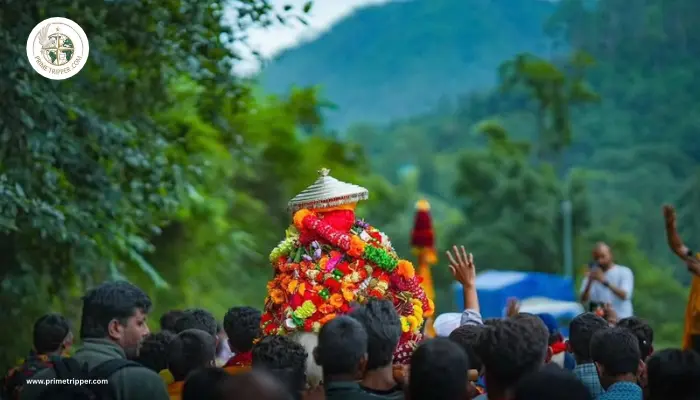
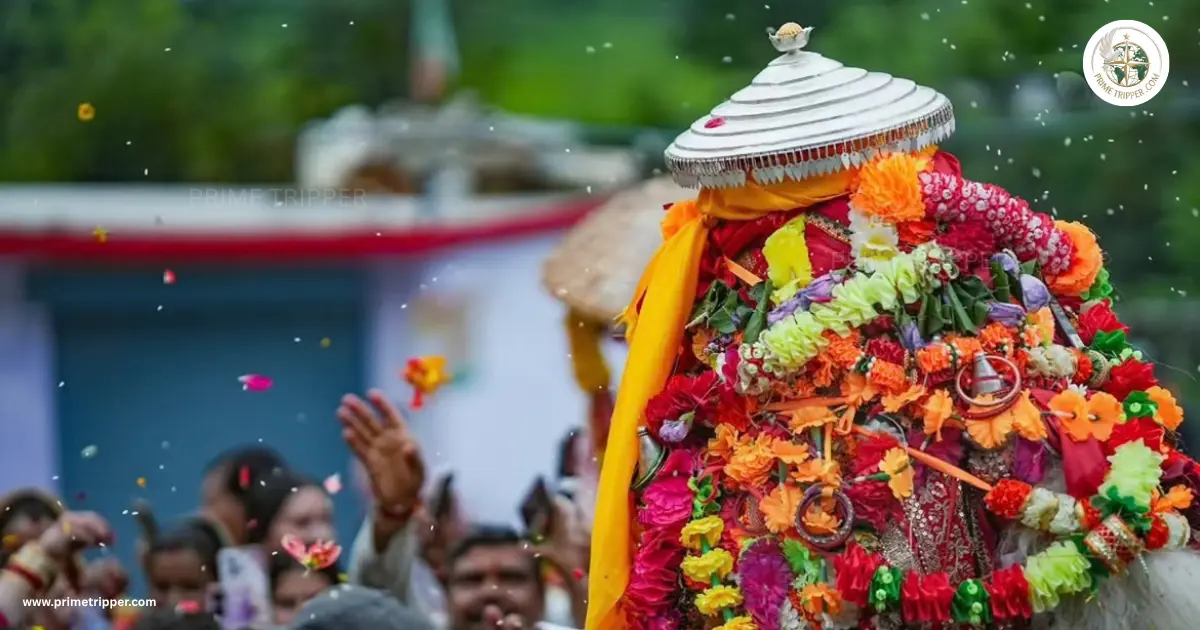
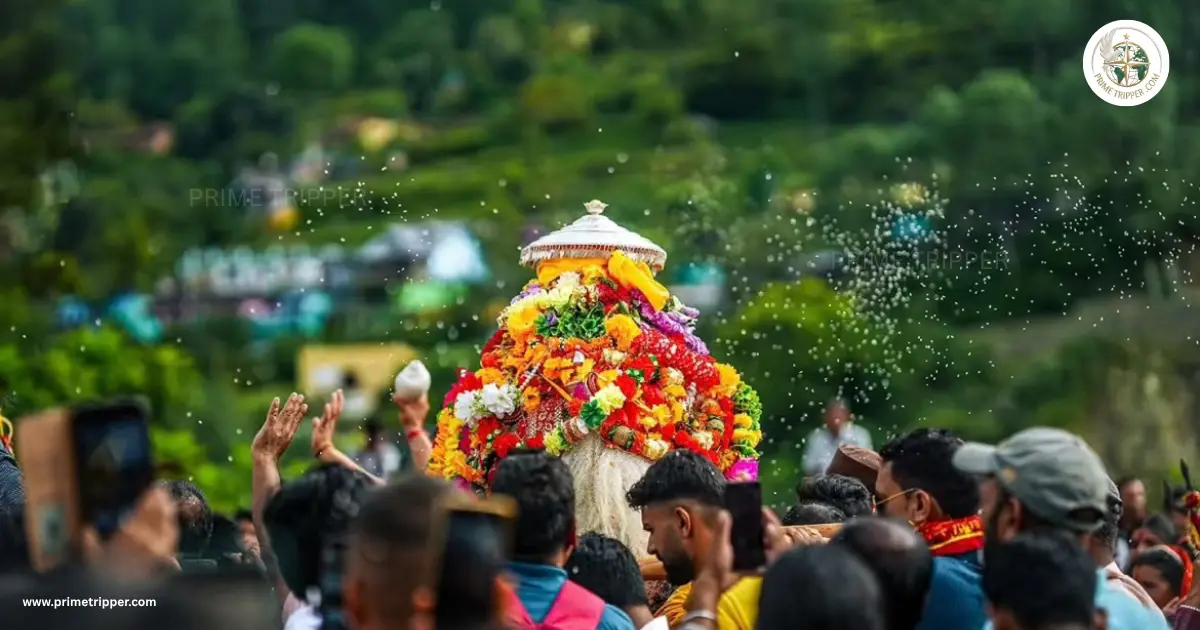
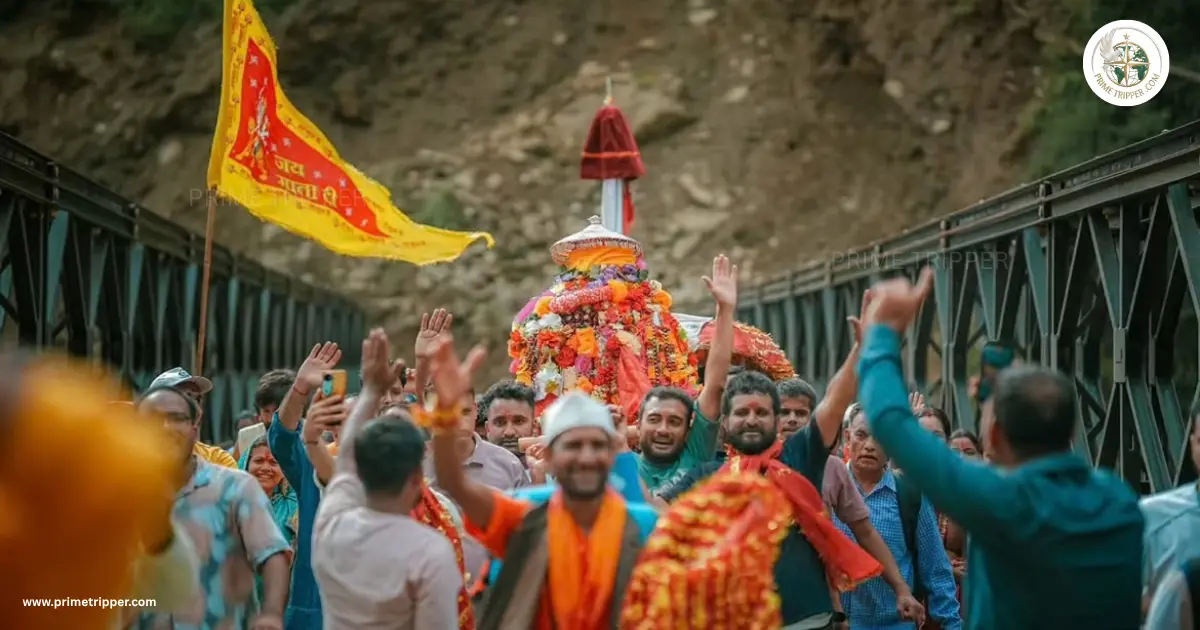
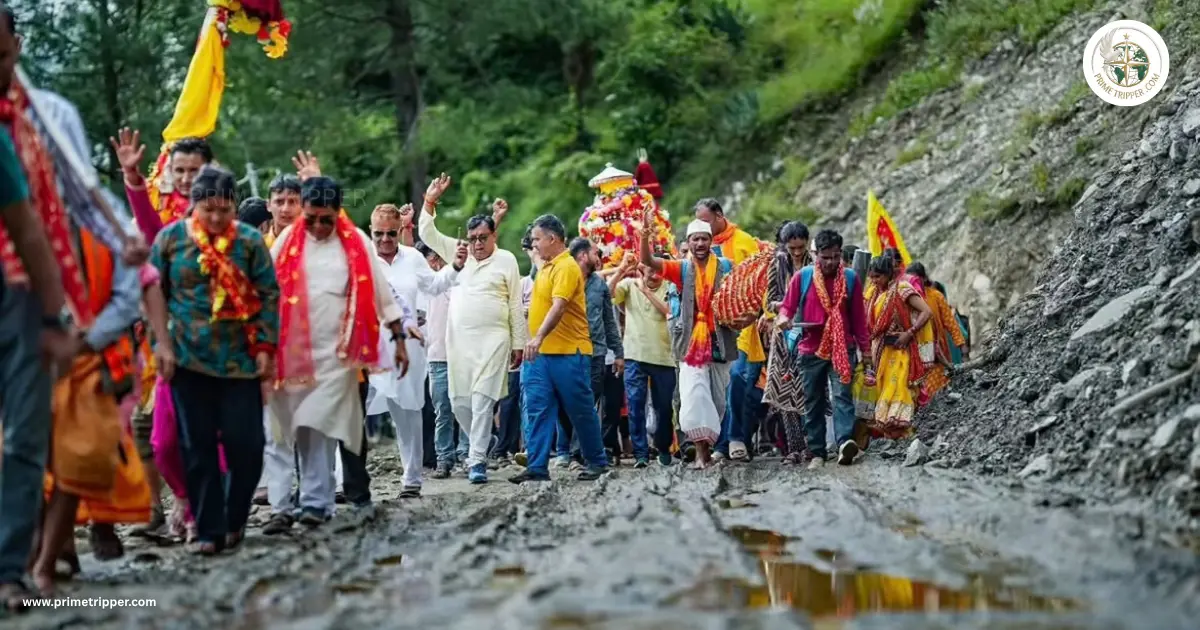
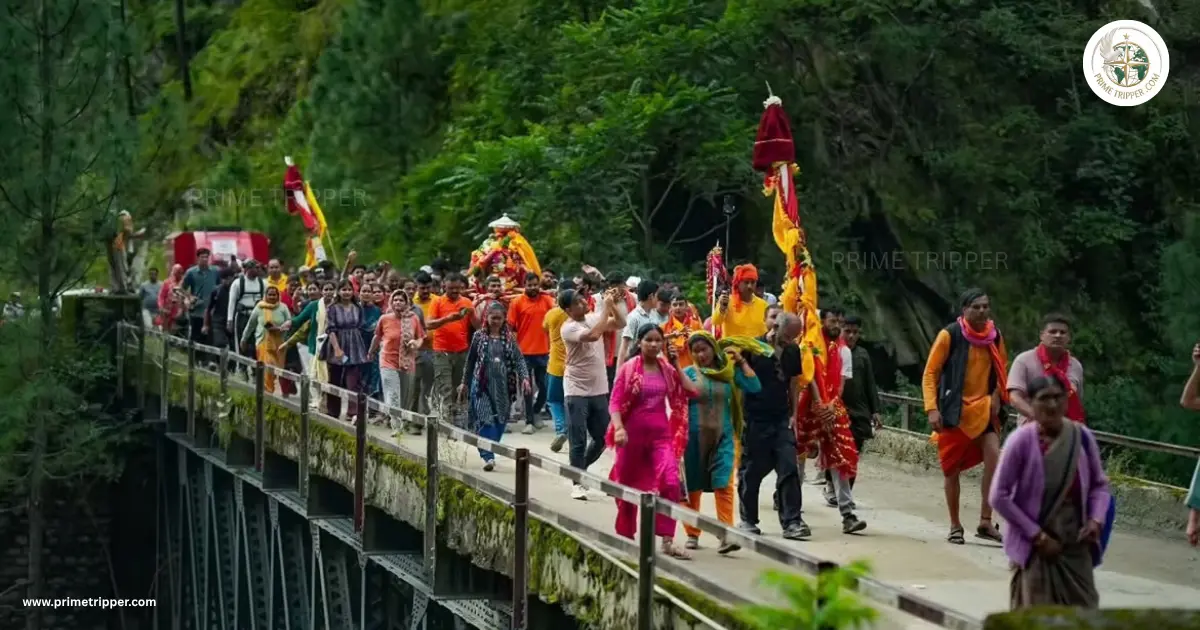
The Nanda Devi Raj Jat Yatra is one of Uttarakhand’s most remarkable religious and cultural traditions.
The pilgrimage is traditionally held once every twelve years and involves a demanding journey through forests, villages, alpine meadows and high mountain terrain. According to accounts of the pilgrimage, the route from Nauti toward Homkund covers roughly 280 kilometres.
This is not a conventional pilgrimage where devotees simply travel from one temple to another.
The landscape itself becomes part of the pilgrimage.
The procession moves through some of the most challenging terrain in the region. Pilgrims cross high passes, walk through meadows and forests, and continue toward the remote Himalayan destination of Homkund.
One of the most distinctive elements of the yatra is the four-horned ram.
The animal traditionally accompanies the procession and is regarded as a guide or messenger. At the end of the pilgrimage, the ram is released toward the high Himalayan region, symbolically carrying offerings to Goddess Nanda.
For the people participating in the yatra, the hardships are not simply physical difficulties. They are part of the spiritual experience.
Walking long distances, dealing with cold weather and crossing difficult mountain terrain creates a sense of sacrifice and devotion that is central to the pilgrimage.
Why Is the Nanda Devi Raj Jat Held Every Twelve Years?
The twelve-year cycle of the Raj Jat is itself surrounded by tradition and legend.
One popular story connects the pilgrimage with King Jasdhawal of Kannauj. According to the traditional account, the king travelled toward the Nanda Devi region with a large entourage.
The journey, however, supposedly became too celebratory. Singing, dancing and festivities disturbed the sacred nature of the pilgrimage.
According to local folklore, Goddess Nanda became angry and punished the travellers. One location along the route became associated with the story of dancers being turned to stone and is known as Patar Nachauni.
The story is part of oral tradition rather than modern historical documentation, but it remains important because it explains how local communities understand the spiritual rules of the journey.
The legend also provides an explanation for the twelve-year cycle of the Raj Jat.
Whether one approaches the story as mythology, folklore or cultural history, its importance lies in the way it has survived across generations.
Nanda Devi and Roopkund: Where Legend Meets Mystery
Few places in the Indian Himalaya have generated as much curiosity as Roopkund.
Often called Skeleton Lake, Roopkund is a small glacial lake situated at high altitude. Human skeletal remains have been found around the lake, creating one of the most enduring mysteries associated with the Himalayas.
Roopkund is also connected with the broader cultural landscape of the Nanda Devi Raj Jat pilgrimage.
Traditional stories tell of a royal procession that was caught in a devastating hailstorm after violating the sanctity of the goddess’s journey. The deaths of the travellers became part of the folklore surrounding the lake.
Modern research, however, tells a more complicated story.
Scientific investigations have shown that the remains at Roopkund did not necessarily belong to a single group that died at the same time. Different individuals appear to have arrived in the area during different periods.
This is an important reminder that Himalayan folklore and scientific research can tell different versions of the same landscape.
The legend gives Roopkund a spiritual narrative, while archaeology and genetics continue to provide clues about what actually happened.
Bedni Bugyal and the Nanda Devi Tradition
The connection between Nanda Devi and the surrounding Himalayan landscape becomes especially visible around Bedni Bugyal.
Bedni Bugyal is one of Uttarakhand’s best-known alpine meadows and lies along the traditional Roopkund route. It is also culturally important because it forms part of the landscape associated with the Nanda Devi Raj Jat.
A small sacred lake, Bedni Kund, is associated with Goddess Nanda.
From the meadows, trekkers can see dramatic Himalayan peaks including Trishul. The combination of open grasslands, mountain views and religious traditions makes the area unique.
For a traveller, Bedni Bugyal may initially appear to be simply a beautiful Himalayan meadow.
For local communities, it carries a much older meaning.
The same landscape can therefore be experienced in two very different ways: as a trekking destination and as sacred geography.
Nanda Devi and the Valley of Flowers
Nanda Devi is also closely connected geographically and environmentally with the Valley of Flowers region.
The Valley of Flowers is famous for its alpine meadows and seasonal wildflowers, while the surrounding Himalayan landscape contains glaciers, high peaks and rare wildlife.
The Nanda Devi and Valley of Flowers region was recognised as a UNESCO World Heritage Site because of its exceptional natural environment.
This area demonstrates another side of Nanda Devi’s importance.
She is not only part of Uttarakhand’s spiritual heritage but also part of a highly valuable Himalayan ecosystem.
The forests, alpine meadows, glaciers and rivers around the Nanda Devi landscape support an extraordinary variety of plant and animal life.
For this reason, protecting the region is not simply about preserving a beautiful mountain. It is also about protecting an entire ecological system.
Nanda Devi National Park and the Sacred Landscape
The Nanda Devi region has long been considered one of the most remote and protected areas of the Indian Himalayas.
The Nanda Devi National Park surrounds the mountain and includes a rugged high-altitude environment that is difficult to access.
The park’s isolation has helped preserve its natural character.
Deep valleys, glaciers, rocky ridges and high mountain peaks create an environment where human access is naturally restricted. The region is also known for its biodiversity.
Species associated with the broader Himalayan ecosystem include snow leopards, Himalayan musk deer, bharal and numerous high-altitude birds and plants.
The protection of the region also reflects an important change in how people approach the Himalayas.
Earlier generations often understood these landscapes primarily through religion and local tradition. Today, conservation science has added another layer of protection.
Both perspectives ultimately point toward the same principle: the mountain should be treated with respect.
The First Successful Ascent of Nanda Devi
Nanda Devi’s spiritual significance is matched by its reputation among mountaineers.
For many years, reaching the summit was considered an enormous challenge.
The surrounding terrain is extremely complicated, with deep gorges and difficult approaches. The Rishi Ganga gorge historically made access to the inner sanctuary particularly challenging.
British climbers Eric Shipton and Bill Tilman explored the area in the 1930s. In 1934, Shipton and Tilman were among the climbers who successfully explored the Rishi Ganga region and entered the area later associated with the Nanda Devi Sanctuary.
Two years later, the mountain was finally climbed.
On 29 August 1936, Bill Tilman and Noel Odell reached the summit of Nanda Devi via the southwest ridge. The peak rises to 7,816 metres.
The achievement was remarkable.
At the time, Nanda Devi was the highest mountain ever successfully climbed. It retained that distinction until the first ascent of Annapurna I in 1950.
The 1936 expedition remains one of the significant milestones in the history of Himalayan mountaineering.
Nanda Devi East or Sunanda Devi
The Nanda Devi massif has two principal summits.
The eastern peak is commonly known as Nanda Devi East and is also called Sunanda Devi. It reaches approximately 7,434 metres.
The first successful ascent of Nanda Devi East took place in 1939. Polish climbers Jakub Bujak and Janusz Klarner reached the summit via the south ridge.
Together, the two summits create the distinctive Nanda Devi massif that dominates the surrounding Himalayan landscape.
The Mysterious Nanda Devi Expedition of the 1960s
Nanda Devi’s history contains another remarkable chapter that sounds almost like a spy novel.
During the Cold War, concerns about China’s nuclear and military capabilities led to a secret American-Indian mountaineering operation in the Himalayas.
A nuclear-powered surveillance device was intended to monitor signals associated with China’s nuclear activities. The equipment was carried toward Nanda Devi by a climbing team.
However, severe mountain conditions prevented the team from completing the mission as planned. The device was left on the mountain and was later swept away by an avalanche.
The story has remained one of the strangest episodes in the history of Nanda Devi.
It also illustrates how the mountain’s remote location and difficult terrain have attracted not only pilgrims and mountaineers but also explorers, scientists and governments.
Why Nanda Devi Is More Than a Trekking Destination
It is easy to look at Nanda Devi through the modern tourism lens.
The mountain is beautiful. The surrounding valleys are spectacular. Nearby trekking routes offer extraordinary views.
But reducing Nanda Devi to a trekking destination misses the most important part of its identity.
For the people of Uttarakhand, the mountain is part of their cultural memory.
Songs, stories, temples, festivals and pilgrimages have kept the traditions associated with Nanda Devi alive.
The Nanda Devi Raj Jat is perhaps the clearest example. It brings together spirituality, geography, folklore and community participation on an enormous scale.
The journey is difficult because the mountain itself is difficult.
That difficulty is not treated as an obstacle to devotion. It becomes part of the devotion.
The Spiritual Meaning of the Himalayan Journey
There is something particularly powerful about pilgrimage in the Himalayas.
A temple in a town can be reached by road. A mountain shrine may require hours or days of walking.
The difference changes the nature of the experience.
The physical effort becomes part of the spiritual journey.
The Nanda Devi traditions demonstrate this beautifully. The pilgrimage takes people away from their everyday surroundings and gradually into increasingly remote landscapes.
Forests give way to meadows.
Meadows give way to rocky slopes.
The air becomes thinner.
The weather becomes harsher.
Eventually, the landscape feels almost completely removed from ordinary life.
For devotees, this transformation is not accidental. It is part of approaching the divine.
Best Time to Experience the Nanda Devi Region
The best time to explore the Nanda Devi region depends on where you plan to go and what you want to experience. For most travellers, May to June and September to October are the most suitable months.
- May to June brings pleasant weather, clearer mountain views and better conditions for exploring the valleys, villages and trekking routes around the region. This is also a good time to see the Himalayan landscape before the monsoon arrives.
- July and August are the monsoon months in Uttarakhand. Heavy rain can make mountain roads and trekking trails slippery, while landslides may cause travel disruptions. If you are planning a high-altitude trek, this period requires extra caution.
- September to October is another excellent window to visit. The rains have usually passed, the skies begin to clear, and the surrounding Himalayan peaks can appear particularly sharp and impressive. The cooler weather also makes outdoor exploration more comfortable.
- From November to April, winter takes over the higher parts of the region. Snowfall can cover trekking routes and make several high-altitude areas difficult or impossible to access. However, lower-altitude villages and temples may still be visited depending on local weather and road conditions.
- Before travelling, check the latest weather forecast, road conditions, forest regulations and trekking permissions for your chosen route. Conditions in the Himalayas can change quickly, so a route that is open one week may not necessarily be accessible the next.
For a comfortable combination of good weather, mountain views and trekking opportunities, May–June and September–October are generally the most suitable periods to plan a trip around the Nanda Devi region.
Best Time for Different Experiences
- For trekking: May–June and September–October
- For mountain views & photography: September–October
- For alpine meadows: May–June, depending on the specific route and seasonal conditions
- For pilgrimage/cultural experiences: Follow the dates and route schedule of the particular Nanda Devi festival or pilgrimage.
Nanda Devi for Travellers, Trekkers and Pilgrims
Different visitors come to the Nanda Devi region for different reasons.
A pilgrim may come to connect with Goddess Nanda.
A trekker may come for the alpine landscapes and mountain views.
A photographer may be drawn by the dramatic Himalayan scenery.
A researcher may be interested in ecology, anthropology or mountaineering history.
And a traveller may simply want to experience a quieter side of Uttarakhand.
The beauty of the Nanda Devi region is that all these experiences can exist together.
But responsible travel is essential.
Visitors should avoid littering, respect religious traditions, follow forest and conservation regulations, and avoid disturbing wildlife.
The Himalayas are fragile, and the increasing popularity of mountain tourism makes responsible behaviour more important than ever.
Nanda Devi: A Mountain That Lives in Memory
Some mountains are remembered because of their height.
Others are remembered because of the climbers who conquered them.
Nanda Devi is remembered for something much larger.
She exists simultaneously as a mountain, a goddess, a cultural symbol, a pilgrimage destination, a protected ecosystem and a chapter in Himalayan mountaineering history.
The stories surrounding her have survived because they continue to mean something to the people who tell them.
The Nanda Devi Raj Jat keeps ancient traditions alive. The mountains preserve the physical landscape behind those traditions. Modern conservation protects the ecosystem, while mountaineering history reminds us how formidable the mountain really is.
Perhaps that is what makes Nanda Devi so fascinating.
She has never been just a peak.
For Uttarakhand, Nanda Devi is part of the relationship between people and mountains — a relationship built on reverence, fear, beauty, hardship and faith.
And when the mountain rises above the valleys, covered in snow and surrounded by clouds, it is easy to understand why generations of Himalayan communities have looked at Nanda Devi and seen something more than stone and ice.
They have seen a goddess.
Conclusion
Nanda Devi is one of those rare places where geography and mythology become impossible to separate.
The snow-covered peak is real. The glaciers and valleys are real. The difficult trails are real. But so are the stories that generations of Himalayan communities have attached to the mountain.
From the Nanda Devi Raj Jat Yatra to the legends of Roopkund, from the sacred Bedni landscape to the historic 1936 ascent, every chapter adds another dimension to the mountain’s identity.
For travellers, Nanda Devi offers breathtaking Himalayan scenery.
For mountaineers, it represents one of the great challenges of the Indian Himalaya.
For conservationists, it represents an ecosystem worth protecting.
And for the people of Uttarakhand, Nanda Devi remains something much more personal — a goddess who has lived in the cultural memory of the mountains for centuries.
That is why Nanda Devi should not simply be described as a Himalayan peak.
It is a living part of Uttarakhand’s heritage.
Frequently Asked Questions About Nanda Devi
Q1. What is Nanda Devi famous for?
Ans: Nanda Devi is famous for its great height, spectacular Himalayan landscape and deep religious and cultural significance in Uttarakhand. It is also famous for the Nanda Devi Raj Jat Yatra and its important place in the history of Himalayan mountaineering.
Q2. How high is Nanda Devi?
Ans: Nanda Devi is 7,816 metres (25,643 feet) high. It is one of the highest mountains in India.
Q3. Why is Nanda Devi considered sacred?
Ans: Nanda Devi is associated with Goddess Nanda, who is deeply revered in Uttarakhand. Local traditions, temples, festivals and the Nanda Devi Raj Jat Yatra all reflect the mountain’s religious importance.
Q4. What is Nanda Devi Raj Jat Yatra?
Ans: The Nanda Devi Raj Jat Yatra is a major Himalayan pilgrimage dedicated to Goddess Nanda. Traditionally held once every twelve years, the pilgrimage travels through villages, forests, alpine meadows and high-altitude terrain toward Homkund.
Q5. Is Nanda Devi connected with Roopkund?
Ans: Yes. Roopkund lies within the broader cultural and trekking landscape associated with Nanda Devi and the Raj Jat tradition. Local folklore connects the skeletons around Roopkund with a legendary pilgrimage and a devastating hailstorm, although scientific research presents a more complex explanation for the remains.
Q6. Who first climbed Nanda Devi?
Ans: Bill Tilman and Noel Odell made the first successful ascent of Nanda Devi on 29 August 1936, climbing via the southwest ridge.
Q7. What is Nanda Devi East?
Ans: Nanda Devi East, also known as Sunanda Devi, is the eastern summit of the Nanda Devi massif. It stands at approximately 7,434 metres and was first climbed in 1939.
Q8. Can tourists visit Nanda Devi?
Ans: The inner Nanda Devi region is highly protected and access is restricted. However, travellers can experience the surrounding Himalayan landscape through permitted routes, villages, pilgrimage sites and trekking areas. Visitors should always check current regulations before planning a trip.
9. What is the best way to experience Nanda Devi?
Ans: There is no single answer. Pilgrims may experience the region through its temples and traditions, while trekkers can explore permitted routes around the surrounding valleys and meadows. For many visitors, learning about the cultural history of Nanda Devi makes the experience more meaningful.

0 Comment